Sharks in Mauritius: where you may see them and where to swim
In Mauritius, sharks live offshore and are rarely a concern in the tourist lagoon. This article helps you tell calm areas from more exposed ones and gives you the right habits to keep in mind before you swim, snorkel or join a guided outing.
Sharks and swimming: we point you to the right spot
Worried about sharks before a snorkeling or diving trip? Ask us on WhatsApp, tell us which hotel you are staying at, and we will suggest an outing suited to the lagoon.
Are there really sharks in Mauritius?
Yes, there are sharks around Mauritius, but that does not make swimming in the lagoon dangerous. At the busiest beach areas, the reef acts as a natural barrier and encounters are rare.
What matters is telling real presence from practical risk. In Mauritius, the question is not “are there sharks?” but “which area are you in, and under what conditions are you getting in the water?”
Sharks in Mauritius at a glance
- 🦈 Sharks exist around Mauritius, but the lagoon is the most reassuring area for swimming.
- 🌊 Risk rises mostly offshore, in reef passes and in deeper water, where current and visibility change.
- 🐠 For a try dive at Belle Mare East with a shark encounter, expect to pay from €135 per person.
- ☀️ In the southern winter, May to November, the sea is often calmer and the lagoons are clearer.
- 💬 For a guided outing, you can organize your excursion with us on WhatsApp.
Which sharks are found around Mauritius?

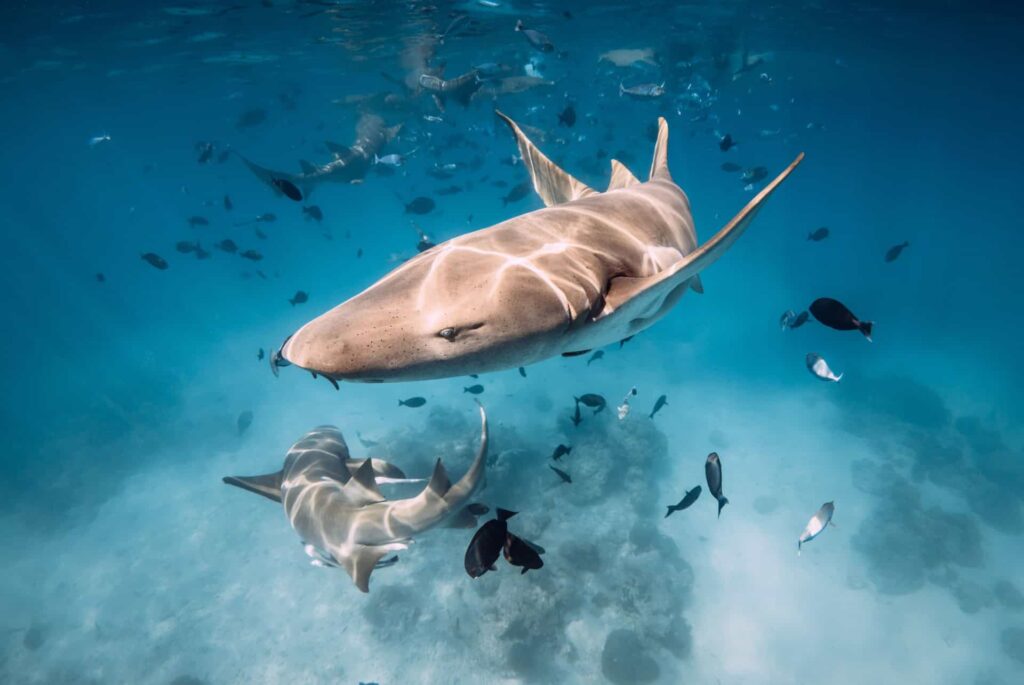
The blacktip reef shark is the most common. It lives near the reef, rarely exceeds 1.5 meters (about 5 feet) and is shy: it keeps its distance and swims away when you come near. It is the one you have a small chance of seeing with a mask, and its presence is nothing to worry about.
The lemon shark tends to frequent the reef passes and deeper areas, where guided divers go. Bull sharks and great hammerheads live offshore: you do not meet them while swimming, and even for divers sightings are rare.
These species rarely approach swimmers. Encounters almost always happen while diving, at a good distance, at sites that the local clubs know well.
Where can you see them around Mauritius?

In the lagoon and near the barrier reef
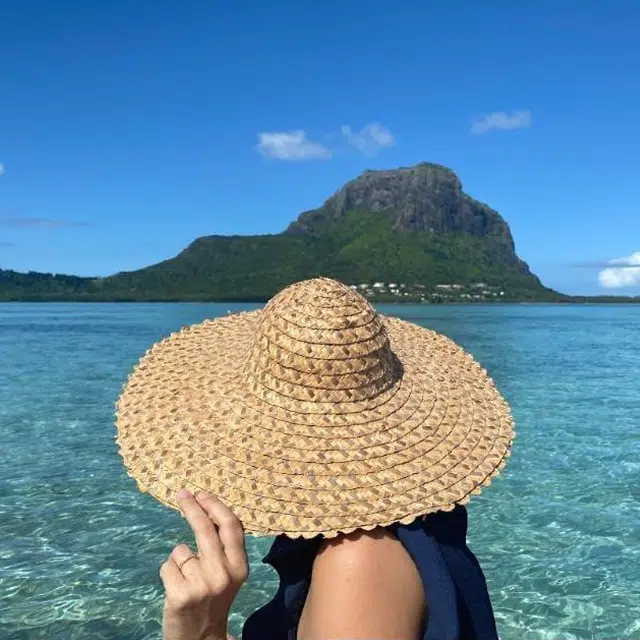
In the Mauritian lagoon, sharks are unlikely in ordinary swimming areas. The public beaches of Mont Choisy, Trou aux Biches, Belle Mare and Le Morne often give access to shallow, clearer water, especially when the sea is calm.
In the morning, visibility is usually better and the lagoons are calmer. In the southern winter, from May to November, conditions are often steadier, which makes it easier to read the water.
Offshore, in reef passes and in deeper water
Offshore is another matter. The farther you are from the reef, the more depth, current and mediocre visibility raise your exposure.
- Note where the reef passes open, since they lead to deep water.
- Stay more alert at dawn and at the end of the day.
- Do not get in the water on a whim if the sea is rough.
- Keep in mind that from the west coast, open water is often closer.
Swimming, snorkeling and diving: what really changes

The comfort level is not the same for each activity. Swimming in the lagoon, snorkeling and diving do not call for the same distance or the same supervision, especially if you want to stay at ease.
Family swimming
Family swimming is very accessible in Mauritius, especially in the calm lagoons of the north and west. Trou aux Biches is often suited to beginners and families, while some beaches on the southwest coast can become less comfortable when swell picks up.
For children or swimmers who are not confident, the goal is not depth but clear water and calm near the shore. A shallow lagoon, like the one at Trou d’Eau Douce, often gives a gentler start.
Snorkeling or guided diving
Snorkeling and diving take more preparation than simple swimming. At Blue Bay, snorkeling is worthwhile when visibility is good, while a dive at Belle Mare East lasts 2 hours and follows a structured format.
- Pick an early morning slot when the water is clearer.
- Keep the group and the guide in your line of sight.
- Skip improvised outings if swell or wind picks up.
JC’s tip
I often see travelers feel confident in the lagoon at 10 AM, then swim too far out as soon as the water looks clear. Use the reef as your reference point and do not go deeper “to see better,” especially if you are not experienced.
What to do if you see a shark
- ✓If you see a shark, stay calm and head back to shallow water without sudden movements.
- ✓The goal is not to flee in panic but to leave the area calmly and steadily.
- ✓Stay together if you are in a group, avoid splashing and do not try to approach the animal.
- ✓If you are snorkeling or diving, tell your guide right away. The guide will arrange for you to surface or head back.
- ✓Never stay in the water if visibility drops sharply or you no longer feel comfortable.
The real risk, based on recorded incidents (and how Mauritius differs from Réunion)

What recorded incidents show
Recorded incidents in Mauritius remain very rare. One notable case involved a ten-year-old injured in the thigh in the Tamarin lagoon, near a hotel. The National Coast Guard at Black River gave quick care, and the child’s condition was reported as not critical.
An event like this does not describe ordinary swimming on the island. It is a reminder that an incident can happen locally, but it does not turn the Mauritian lagoon into a permanent risk zone.
The coral barrier changes everything
The difference with Réunion comes down to the shape of the coastline. In Mauritius, the lagoon is protected by a nearly continuous coral barrier that strongly limits access by large species to the busiest beaches.
This barrier acts as a natural filter. It explains why most tourist activities take place in a shallow lagoon, far from the open-sea conditions where sharks are more likely.
What this means for you in practice
In practice, you can swim with confidence in well-sheltered lagoons, especially when the sea is calm. Normal caution applies again once you cross a reef pass, head offshore or conditions change during the day.
The sensible approach is to choose a sheltered beach, check the state of the sea and call it off when the swell rises. In Mauritius, you manage the risk mainly by choosing the place, the time of day and the type of outing.
Before heading out to sea

In Mauritius, sharks exist, but the risk to a traveler stays low in the lagoon and needs more attention once you head offshore. Keep three simple habits: favor sheltered areas, go early when the water is clearer, and follow a guide if you snorkel or dive.
- Stay in the lagoon when you want simple swimming.
- Be more careful around reef passes, currents and the open sea.
- Book an outing suited to your level if you want peace of mind.
- Contact us on WhatsApp to organize your excursion.
On the water, with peace of mind
Kayaking on the Tamarin River, by day or at sunrise, and a private catamaran to the northern islands.
-
 Mangrove and pools
Kayaking on the Tamarin River (2.5 hours)
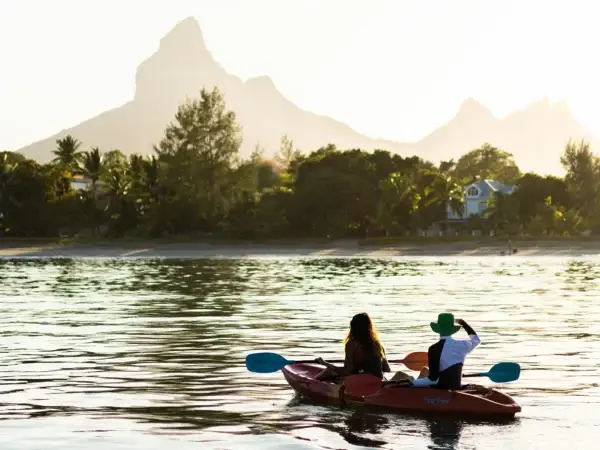
Paddle up the Tamarin River between mangrove and mountains, as far as the freshwater pools.
€35.00 -
Sunrise
Sunrise kayaking on the Tamarin River (1.5 hours)
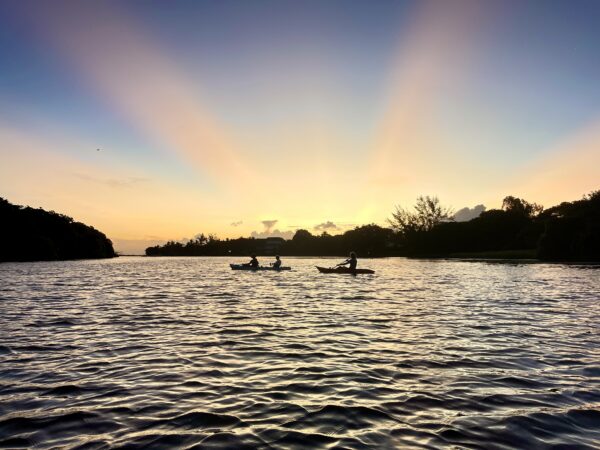
Sunrise over the Tamarin River, from a kayak, in the quiet of early morning.
€35.00 -
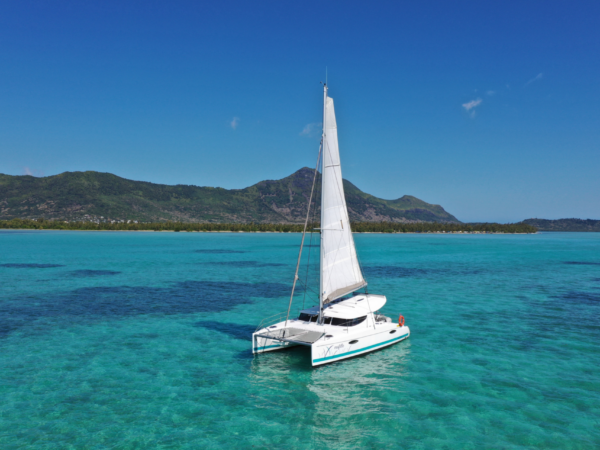
Private catamaran
Day trip to the 3 northern islands on a private catamaran
The catamaran all to yourselves, out to Coin de Mire, Flat Island and Gabriel Island: snorkeling, a barbecue on board and drinks.
€750.00 / day

Jean-Christophe (JC)
Lagoon or open sea, let’s book the outing that suits you
Family swimming, snorkeling or guided diving: tell us on WhatsApp the activity, your dates and everyone’s level, and we book it with a local operator.
FAQ about sharks in Mauritius
No, it is not necessarily too risky if you pick an outing designed for beginners and a calm lagoon. At Belle Mare East, a try dive is led by PADI-certified instructors and starts with a first dive in a pool, which reassures many travelers.
The real point of caution is not to confuse curiosity with your actual level. If you feel stressed in the water or the sea is rough, stay with simple swimming or very closely guided snorkeling.
What you mainly need to avoid are beaches or moments when the sea becomes more exposed, not the whole island. Le Morne can be a poor choice when swell or wind picks up on the southwest coast, while a calm lagoon in the north stays more comfortable.
The right strategy is to check the state of the sea before getting in the water. If visibility drops or you feel current, move to another spot rather than push on.
Yes, they can be if you go on an organized outing suited to your level. The Bassin aux Requins (Shark Pit), for example, lies 12 meters (about 40 feet) deep, requires a minimum of 30 dives and is not accessible year-round.
So this is not an outing to improvise. Supervision, weather and your experience should decide the departure, not the wish to “see a shark” at any cost.
The danger is often exaggerated for Mauritian beaches, but real incidents have happened. A ten-year-old child was injured in Tamarin, which shows that it can happen, though it is not the norm for swimming in Mauritius.
The right way to think about it is neither constant fear nor shrugging it off. What matters is telling apart the tourist lagoon, the passes and the open sea, since exposure is not the same.
For a traveler, the most problematic animal is not necessarily the one you picture first. At sea, the main risk depends on the swimming context, the sea conditions and the area chosen, not on a constant presence of large sharks near beaches.
In practice, the most useful caution is on-the-ground caution: choose the spot well, avoid poor conditions and follow supervision. We help you organize a suitable outing if you want to go ahead with peace of mind.