
Mauritius currency: what to know about the rupee
Here is what you need to know about the currency of Mauritius, the Mauritian rupee, to manage your vacation budget.
Online Mauritian rupee converter
Before we get into the details, we know that our French-speaking readers come from all over the world, mostly France, Belgium and Switzerland.
Money and payments matter a lot when you travel.
To avoid foreign bank fees (card use and currency conversion), we recommend services such as Revolut and Boursobank. Here are our referral links, so you can take advantage of their welcome offers.
Why does Mauritius use the rupee?
Under French and then British rule, Mauritius first used the currencies of its colonizers. The pound sterling was used until 1877, when the Indian rupee replaced it. The Mauritian rupee only became the official currency in 1934. Issued by the Bank of Mauritius, created the same year, it symbolizes the country’s gradual emancipation and lays the foundations of its modern financial system.
Over the decades, Mauritian coins and notes have carried designs showing the island’s natural and cultural heritage. Iconic landscapes, such as Le Morne Brabant or the sugar cane fields, sit alongside historical figures such as Sir Seewoosagur Ramgoolam, father of independence. Travelers can get a feel for the island’s soul through its money.
See also: When to go to Mauritius?
Mauritius currency: the Mauritian rupee
The official currency of Mauritius is the Mauritian rupee (MUR). Its exchange rate is fairly stable, at around 45 to 50 rupees to the euro (check today’s rate on a currency website when you plan your trip, or use the widget at the top of the page).
You can travel with euros or US dollars and change them locally at bureaux de change or banks for Mauritian rupees, or spend your euros with some businesses that accept them.
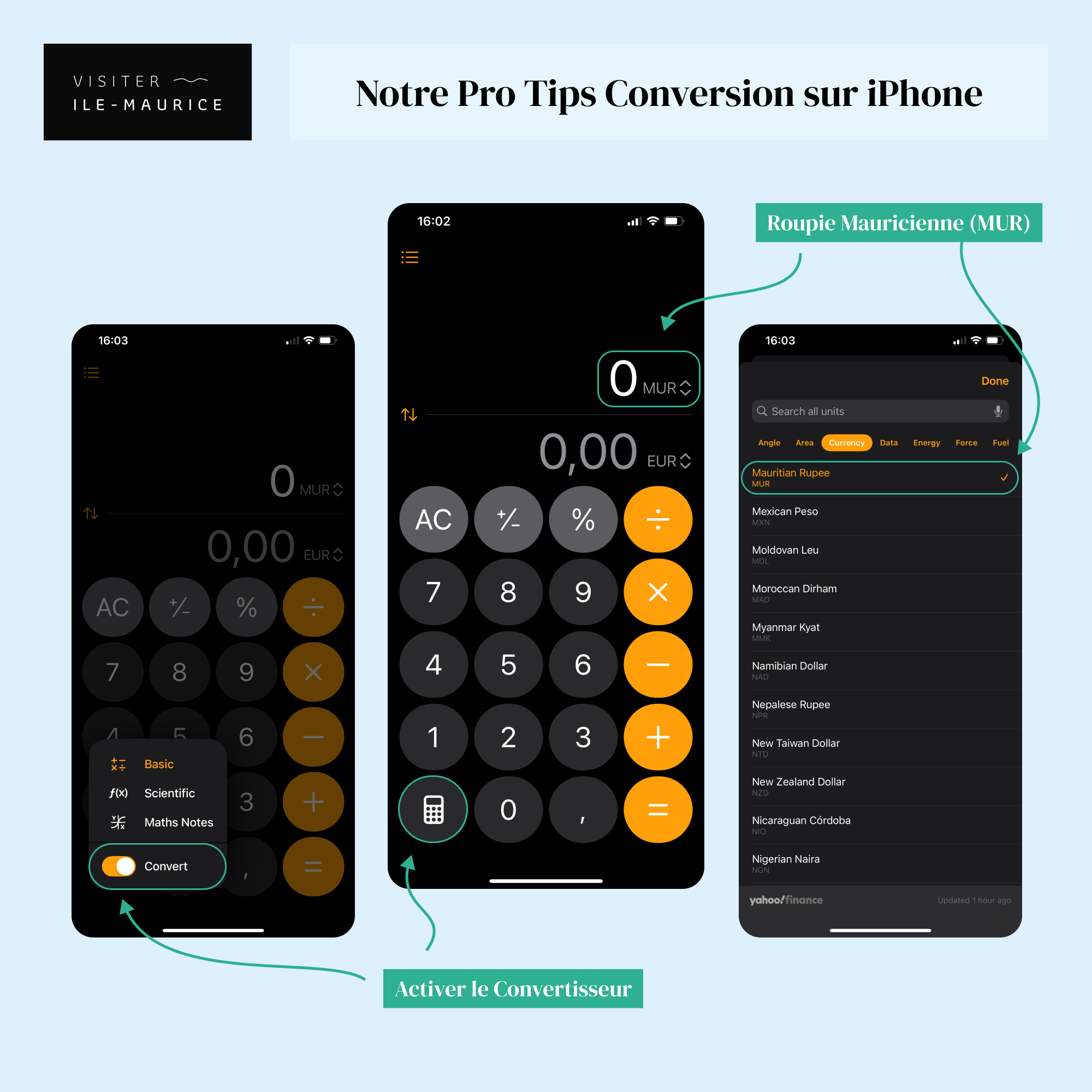
To make conversions easier on an iPhone, open the Calculator, tap the button at the bottom left (calculator symbol) in the menu that appears, turn on currency conversion, then select MUR as the reference
Where to change money in Mauritius
You can exchange money at the exchange offices at Sir Seewoosagur Ramgoolam International Airport, and in the island’s main towns such as Port Louis, Grand Baie, Flic en Flac or Tamarin/Black River, for example.
Banks also offer this service, usually at good exchange rates.
Some hotels will also change your money into rupees, but their fees are fairly high.
Check business hours and bring your passport when you change money.
Card payments and cash withdrawals in Mauritius
Most hotels, restaurants and shops on the island accept card payments, notably Visa and Mastercard. Check the fees your bank charges for payments and withdrawals abroad.
ATMs are available in the main towns and tourist areas, so you can withdraw Mauritian rupees directly with your bank card.
Note that withdrawals are capped at most ATMs, so if you need a large amount, plan to take it out in several withdrawals.
Some bank cards, such as those from BoursoBank, Revolut or N26, allow withdrawals and payments at the day’s rate with no commission (check the terms with each bank).
Our tips for managing your budget in Mauritius
To avoid unpleasant surprises, plan a budget that fits the length of your stay and the activities you have in mind.
Prices in Mauritius are generally lower than in Europe, but some leisure activities such as excursions, water sports or fine-dining restaurants can quickly push up the bill.
Book some services in advance to get better prices.
See also: Budget in Mauritius
FAQ
Although the Mauritian rupee is the official currency, the main foreign currencies such as the euro, US dollar or pound sterling are widely accepted in hotels, restaurants and tourist shops.
It is still better to pay in Mauritian rupees to avoid poor exchange rates, and to carry rupees for small purchases and local transactions.
ATMs are spread across the island, including outside the main tourist areas. However, the number varies by region. In rural or less populated areas, they can be farther apart. Plan ahead and take out enough cash when you visit more remote regions.
International credit cards such as Visa and MasterCard are widely accepted at most hotels, restaurants and shops in Mauritius. However, at local markets, small shops and some more remote places, you may only be able to pay in cash. Ask how you can pay before you shop or order a meal.
Travelers can bring any amount of foreign currency into or out of Mauritius. However, if you carry USD 10,000 or more (or the equivalent in another currency), you must declare it to customs on arrival and on departure. For the local currency (the Mauritian rupee), check the current limits before you travel, as they can change.
To keep bank fees down when withdrawing cash, consider the following options:
- Use a bank card suited to international travel, with good terms for withdrawals abroad.
- Withdraw larger sums less often to reduce the number of transactions and so the fixed fee per withdrawal.
- Ask your bank whether it has agreements with Mauritian banks that reduce or remove withdrawal fees.
Pay by card where you can, so that you do not need to withdraw cash often.

Mehdi
Need some advice?
Our team will help you by phone, free of charge, to choose the option that suits you best. Contact us on WhatsApp