Rodrigues Island: a travel guide
Looking for something authentic? This guide to Rodrigues Island, part of Mauritius, covers its history, its geography and our top 10 things to do.
Add Rodrigues to your Mauritius trip
Thinking of adding a few days in Rodrigues to your Mauritius trip? Message us on WhatsApp with your dates and what draws you to the island, and we will work out how to fit it in.
Customer service available
Secure payment
Instant booking
Rodrigues Island: what to know
Rodrigues Island sits in the middle of the Indian Ocean and is well worth adding to a Mauritius trip. Less well known than Mauritius, which it belongs to, it wins visitors over with its natural beauty, authenticity and friendly people.
In this guide we cover the island’s main attractions, from white-sand beaches to local traditions, to help you plan your trip and make the most of this far-flung destination.
History of Rodrigues Island
Discovery and exploration (16th century)
Portuguese navigators first sighted Rodrigues in the 16th century. Among them was the explorer Diogo Rodrigues, who gave the island its name.
But the island stayed uninhabited for some time, serving only as a landmark for Portuguese sailors crossing the Indian Ocean.
The Dutch and the French arrive (17th century)
In the 17th century the Dutch became the first Europeans to take an interest in Rodrigues, but they did not settle there. The island remained a stopover where ships took on water and food, notably giant tortoises, which were hunted for their meat.
In the early 18th century the French took possession of Rodrigues as part of the expansion of their colonial empire. They tried to exploit the island’s natural resources, notably timber and tortoises, but struggled with its isolation and its sometimes harsh weather.
French rule and economic development (18th century)
Under the French, Rodrigues became part of the colony of Île de France (today Mauritius). French settlers and enslaved Africans were brought to the island to develop farming and use its natural resources. During this period sugar growing took hold, along with cattle raising.
The settlers also brought French traditions and cultural influences that have lasted over time. Rodriguan Creole, a variant of Mauritian Creole, gradually emerged and became the main language of the islanders.
Under British rule (19th century)
In the early 19th century, after the Napoleonic Wars, the British took possession of Rodrigues, together with Mauritius, in 1810. Although the island was under British rule, French and Creole traditions continued to shape local life strongly.
In 1835 the British abolished slavery, a decision that deeply changed Rodriguan society. Formerly enslaved people became free citizens, and the population turned to farming and fishing to make a living.
Isolation and self-reliance (20th century)
For much of the 20th century Rodrigues remained an isolated island, far from the main trade and communication routes. This relative isolation encouraged a self-reliant culture: Rodriguans grew their own food, raised cattle and lived mainly from fishing.
This self-reliance forged a strong community spirit and distinctive cultural traditions, such as séga tambour music, traditional dance and local cooking shaped by Creole recipes.
Part of the Republic of Mauritius (since 1968)
In 1968 Mauritius became independent and Rodrigues joined the new republic. Although it belongs to Mauritius, Rodrigues has had greater autonomy since 2002, with a regional council that runs its internal affairs.
This autonomy lets Rodriguans make decisions better suited to life on a small island.
Culture and conservation today
Today Rodrigues is an increasingly popular tourist destination, but it has kept its authenticity and its traditions. Protecting its environment and its endemic wildlife and plants is a priority for the authorities and the islanders. The François Leguat Park, where giant tortoises are protected, and the Grande Montagne nature reserve show this commitment to preserving the island’s natural heritage.
Rodrigues keeps a simple, close-knit way of life in harmony with nature. Islanders welcome visitors warmly and share a rich culture shaped by centuries of history and life on a small island.
Geography and climate
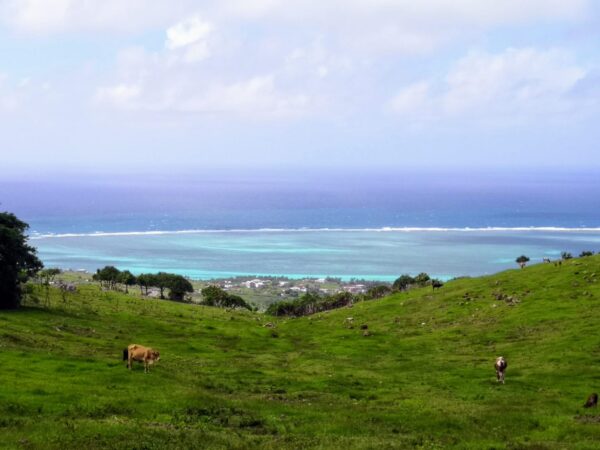
About 580 kilometers (360 miles) east of Mauritius, Rodrigues covers 108 km² (about 42 sq mi) and is surrounded by clear lagoons twice its size.
Rodrigues has a tropical climate with pleasant temperatures all year, though many visitors prefer the dry season, from May to November, for outdoor activities.
Read more: The best times to visit Mauritius.
The best beaches in Rodrigues
Rodrigues Island is known for its beautiful beaches, surrounded by turquoise lagoons and unspoiled scenery. Each beach has its own charm, whether it is a quiet spot for relaxing or a lively one for water sports.
Here are the best beaches in Rodrigues and where to find them:
1. Trou d’Argent
On the east coast of the island, Trou d’Argent is arguably the most iconic beach in Rodrigues.
You can only reach this small cove on foot, after a short hike from Saint-François beach. Rocky cliffs form a kind of secluded bay around it. Its white sand and clear water make it ideal for swimming and snorkeling.
2. Saint-François
A few minutes’ walk from Trou d’Argent, Saint-François beach is a wide stretch of white sand lined with casuarina trees, with calm, shallow water.
This beach is ideal for relaxing, family swimming and snorkeling, with direct access to the coral reef. It draws many visitors for its beauty and calm, but stays relatively free of crowds.
3. Pointe Coton
In the northeast of the island, Pointe Coton is another popular beach with fine sand and turquoise water. Framed by lush tropical vegetation and a few rock formations, it is perfect for swimming and sunbathing. The currents are sometimes stronger, which also makes it a good spot for water sports fans.
Several hotels and guesthouses are nearby, with lovely views of the ocean.
4. Graviers
On the southeast coast of Rodrigues, Graviers beach is a long white-sand beach dotted with small rocks.
Locals and fishermen like it, and it is a good starting point for reaching the secluded coves nearby, such as Anse Bouteille. The water is calm, and it is a good place for a quiet stroll or to watch small-scale fishing.
5. Anse Bouteille
Not far from Graviers, Anse Bouteille is a picturesque, wild beach tucked between cliffs. It is harder to reach, but worth the effort.
A perfect spot for adventurers and photographers, with clear water and an end-of-the-world feel. Because it is hard to reach, it stays quiet and unspoiled, ideal for anyone looking for a private corner.
6. Anse aux Anglais
Anse aux Anglais is near Port Mathurin, the capital of Rodrigues. The beach is named after the British sailors who once set up camp there. Today it is a lively spot where you will meet both locals and visitors.
Anse aux Anglais is not as remote as some other beaches, but it has a lovely ocean view and easy access to amenities. It is also a good place to watch the sunset.
7. Baie aux Huîtres
The Baie aux Huîtres, in the Port Sud-Est area, is an unusual beach because of its special ecosystem.
This sheltered bay is known for its oyster beds and its mangrove. Its calm water is ideal for a kayak or boat trip, letting visitors see the marine wildlife and plants of Rodrigues, including tropical fish and seabirds.
8. Baie de l’Est
In the east of Rodrigues, Baie de l’Est is a peaceful beach with a lovely view over the lagoon. It is a top choice for anyone who wants nature all to themselves.
Few tourists come here, so the bay is perfect for activities such as kayaking, fishing or hiking along the coast.
9. Île aux 2 Cocos
Although separate from the main island, Île aux 2 Cocos, a few kilometers off the northwest coast, is a worthwhile detour for anyone who loves idyllic beaches.
Reached by boat from Port Mathurin, this island is a nature reserve for seabirds, with pristine white-sand beaches. Visitors can swim, watch birds in their natural habitat and enjoy the quiet.
Things to do in Rodrigues: our top 10
Rodrigues suits travelers who want nature, quiet and authentic adventure.
Here are our top 10 favorites in Rodrigues:
1. Hikes and walks
Trou d’Argent: A hike not to miss, leading to one of the most spectacular beaches on the island. The path has great views of the lagoon.
Grande Montagne Reserve: Walk through this nature reserve, home to endemic birds and plants, perfect for nature lovers.
2. Scuba diving and snorkeling
Rodrigues is known for its coral reefs and colorful marine life. The lagoon is ideal for snorkeling and diving, notably at Saint-François or around Île aux Cocos.
Read our article on scuba diving in Mauritius.
3. Trips to the surrounding islands
Île aux 2 Cocos and Île aux Sables: Boat trips visit these remote islands, perfect for watching rare seabirds and enjoying untouched beaches.
4. Water sports
Kitesurfing and windsurfing: The steady wind in Rodrigues makes it a perfect place for kitesurfing, notably at Anse Mourouk.
Kayaking: Paddle the lagoons and secluded coves for a quiet day on the water.
5. Ziplining: adventure up high
For thrill seekers, Rodrigues has a standout activity: ziplining. In the Montagne Malgache area, the zipline carries visitors over the treetops with a clear view of the turquoise lagoon far below.
With courses of different lengths and heights, it suits adventurers of all ages. The longest lines reach up to 400 meters (1,300 feet), a mix of adrenaline and big views.
6. Traditional fishing
Join local fishermen on a fishing trip to see this traditional activity. Fishing is part of the history and culture of Rodrigues.
7. Giant tortoises
The François Leguat Park is where you can see giant tortoises and learn the story of their conservation.
8. Local culture and food
Village visits: Spend time in the small villages to see local crafts, fresh produce markets and the warm welcome of Rodriguans.
Traditional dance: Watch a traditional séga tambour dance, often with singing and local percussion.
Try Rodriguan cooking, with typical dishes such as octopus curry, achards and local fruit jams.
9. Caving in Rodrigues
Visit the limestone caves of Caverne Patate, a network of tunnels that runs for several hundred meters.
10. Relaxing on the beaches
Rodrigues has many secluded beaches, such as Pointe Coton and Graviers, where you can unwind far from the crowds.
Practical tips for traveling to Rodrigues
🛵 Getting around
The best way to get around the island is to rent a scooter or a car and go at your own pace.
To get to Rodrigues, you can book a domestic flight from Mauritius, or a flight from Réunion.
⛑️ Health and safety tips
Rodrigues is a safe destination, but take precautions against mosquito bites and respect the natural environment.
🛌 Where to stay in Rodrigues
Hotels: Many hotels and resorts welcome visitors, from small guesthouses to luxury properties.
Alternative accommodation: Guesthouses and vacation rentals give you a more personal, authentic stay.
Agnès and JC’s tip
Rodrigues is a small island, so book your accommodation and rental car ahead of time (supply is limited).
Rodrigues Island combines natural beauty, calm and a rich culture, in a place that feels outside time. It makes for a memorable trip, a world away from home.
Do not wait: this little corner of the world is still off most travelers’ radar.

Agnès
Sold on Rodrigues? Let’s build your plan
Tell us on WhatsApp how many days you plan to spend in Rodrigues and which activities caught your eye in our selection, and we will suggest accommodation and a plan for the island.
Rodrigues Island FAQ
May to November is ideal, with a dry, pleasant climate that suits outdoor activities.
Most people in Rodrigues speak Rodriguan Creole, which is close to Mauritian Creole. French and English are also widely used, especially in business and government.
Rodrigues is an autonomous island under the jurisdiction of the Republic of Mauritius, so Rodriguans are Mauritian citizens.
The official currency in Rodrigues is the Mauritian rupee (MUR), just as in Mauritius. You will find banks and currency exchange offices in Port Mathurin, the capital of Rodrigues.
The most common way to get to Rodrigues is to fly from Mauritius, which takes about 1.5 hours. Sea connections may also exist, but they are rare and take much longer.
Renting a scooter or a car is recommended for getting around the island on your own. As in Mauritius, you drive on the left.