Languages spoken in Mauritius
Which languages are spoken in Mauritius? English, French and Mauritian Creole share the island, and each one has its own role. Here is how they came to live side by side.
Planning a vacation in Mauritius and wondering whether you will be able to communicate once you get there? Do they speak English in Mauritius? 🤔
Rest assured: English and French are understood by most Mauritians, so you will be able to talk with people easily during your stay.
Most people in Mauritius speak several languages, a reflection of the island’s rich, multicultural history.
Curious about Mauritian culture?
See its diversity on the plate too, with our cooking classes!
In short:
- In Mauritius, English and French are widely understood and spoken by most Mauritians, which makes communicating easy for travelers.
- Understand the origin of this multilingualism through the country’s history, and tell the official language (English) apart from the spoken languages (French and Creole).
Mauritian Creole: the language of the heart. “Kreol morisien” is the mother tongue of nearly 90% of the population and shapes the country’s cultural identity. Born from a blend of African and European languages, it is the language of daily life, of music (like sega) and of local expressions.
Languages in Mauritius: a multicultural, historical heritage
🇬🇧 English, the language of administration and writing
Although English is the language of the National Assembly under Article 49 of the Mauritian constitution, it is mainly used in institutions, education and international business.
In writing, English is by far the most common: if you receive an official or administrative communication, it will be in English.
🇫🇷 The role of French in Mauritian society
French, although only unofficially recognized, is everywhere in the media, in culture and in social life, and it plays a role that complements English. Along with Creole, French is the main spoken language, while Creole remains what you could call the mother tongue of most Mauritians.
The local languages Mauritians speak
🔸 Mauritian Creole, the everyday language
Origins of Mauritian Creole
Born from a mix of African and European languages, Creole is spoken today by nearly 90% of Mauritians.
Its role in local culture and identity
A living, accessible language, Creole is the glue of national identity. You hear it in songs (especially Mauritian sega), in stories and in everyday conversation.
🇮🇳 Indian languages: Bhojpuri, Tamil and others
The Indian community, the largest on the island, keeps its roots alive through Bhojpuri, Tamil, Telugu and Hindi, used in religious practice and at home.
Other languages are spoken too (Chinese, Arabic and more)
Chinese, especially Hakka, and Arabic, linked to the Muslim community, round out this multilingual picture.
A short Mauritian Creole phrasebook for travelers
| English | Mauritian Creole |
|---|---|
| How are you? | Ki manyer? (or: ki position?) |
| Everything is fine | Tou korek |
| Hello, I’m looking for… | Bonzour, mo pe rod… |
| See you tomorrow | Trouv ou Dimin |
| Thank you | Mersi |
| My name is… | Mo apel… |
| What is your name? | kouma ou apele? |
| I’m on vacation | Mo pé pass vakans |
| How much does it cost? | Komié été ? |
| I don’t understand | Mo pa konpran |
| Do you speak French? | Ou koze fransé ? |
| It’s delicious! | Li mari bon! |
Just for you, and just for fun…
JC shares a few typical Mauritian Creole expressions
Mo content twa = I love you
(A very common, affectionate expression)
Pa kass latete = Don’t worry / No problem.
(Used to reassure someone)
Aret fer tapaz = Stop making so much noise!
(Typical in lively Mauritian homes 😄)
Lacé soulié klaté (the shoelaces have snapped) = It was delicious, I ate far too much
(a way of saying you are stuffed)
Baté rendé pa fer dimal = A blow returned doesn’t hurt
(Often used by kids on the playground, or when someone puts the other person in their place in a heated conversation)
Labitide pa ventar = With practice, you know your subject (lit. the road like water).
(An expression meaning that saying you know something because you have done it is not boasting)
Tire zef dan fess poul = Pulling the egg out of the hen’s behind
(Said of people who can’t be patient and wait for the right moment)
Lapat zourit = Octopus tentacle
(Said of someone with lots of connections, a big network)
Bef travay, souval manzé = The ox works and the horse eats
(a protest against exploitation)
JC’s tip
Don’t be shy about trying a few words of Creole. Mauritians appreciate visitors who make the effort. Mauritian Creole is spoken with a smile: a simple “Ki maniere?” can break the ice anywhere.
Mauritius is a striking example of languages living together, where each one tells part of the island’s story.
The future looks promising for Creole and the minority languages, and the challenge will be to keep this balance while embracing modern change. A bill was introduced in May 2025 to finally recognize Kreol morisien as an official language of Mauritius.
See the full range of language and culture in Mauritius, plus the great activities you can do on the island:
And to see the island up close
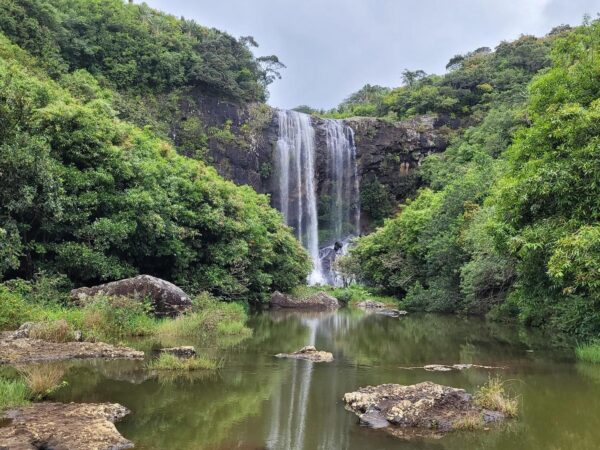
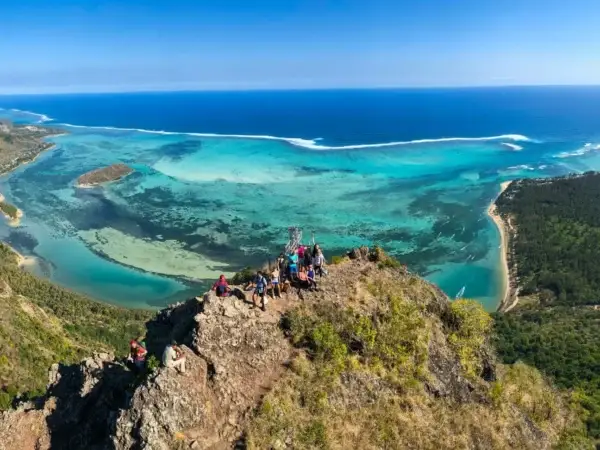
Four activities you can book online: the Tamarind Falls hike (the 7 Cascades), the Le Morne Brabant hike, kayaking with dolphins and swimming with horses.
-
 The classic
Tamarind Falls hike (3 hours)
The island’s best-known hike, to Tamarind Falls, in a small group, with a swim in the natural pools.
€39.00 -
UNESCO summit
Le Morne Brabant hike (4 hours)
The climb up Le Morne Brabant, a UNESCO site, to the summit and its view over the southwest lagoon, with a certified guide.
€45.00 -
At dawn
Kayaking with dolphins in Tamarin Bay (2.5 hours)
At sunrise, by kayak in Tamarin Bay, to meet the dolphins that come here to rest.
€46.00 -
From age 6
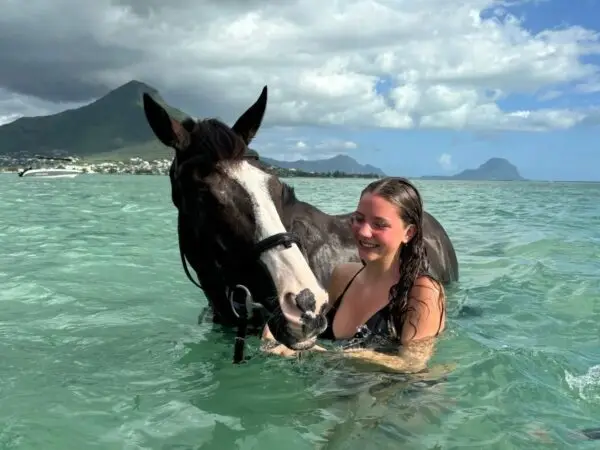
Swimming with horses at Flic en Flac (1 hour)
A horseback ride along Flic en Flac beach, then a swim with your horse in the lagoon, from age 6.
€90.00 / 3 hours

FAQ on languages in Mauritius
Mauritian Creole and French are the most widely spoken languages on the island. Nearly 90% of Mauritians use Mauritian Creole in daily life.
More than ten languages are recognized in Mauritius, including Creole, French, English, and Indian and Chinese languages.
In Mauritian Creole, “hello” is simply “Bonzour”.
French is spoken because of the island’s French colonial heritage, which left a deep mark on its culture and language habits, even after British rule began.