
Bats in Mauritius: everything to know about the Mauritian flying fox
The most visible bat in Mauritius is the Mauritian flying fox, a large endemic mammal that comes out mostly at dusk and at night. This article helps you recognize it, understand its role in the forests and know where to watch it without disturbing the animal.
Watching the Mauritian flying fox on your trip
It comes out mostly at dusk. If you want to see it, tell us on WhatsApp where you are staying and we will suggest a good spot, without disturbing the animal.

The Mauritian flying fox in 5 minutes
The Mauritian flying fox, or Pteropus niger (called “roussette noire” in French), is the best-known bat in Mauritius. It is about 23 cm (9 inches) long, with a wingspan of 80 cm to 1 meter (31 to 39 inches) depending on the animal.
It lives in large groups in the trees, comes out mostly at dusk, then looks for fruit and nectar during the night. It is harmless to people. It is a well-loved animal on the island. This article explains why it matters for Mauritian forests.
Bats in Mauritius at a glance
- 🦇 The Mauritian flying fox is the largest endemic land mammal in Mauritius.
- 🌙 It comes out mostly at dusk and at night, in groups in the trees.
- 🍈 Its diet is strictly fruit and nectar, so it feeds on fruit and flowers.
- 🌳 It disperses the seeds of more than 40 native tree species.
- ⚠️ The species is listed as “Endangered” and its population has dropped by more than 50% since 2015.
How to recognize a bat in Mauritius

Its size and wingspan
The Mauritian flying fox stands out first by its size. With a body of about 23 cm and a wingspan of up to 1 meter, it is nothing like a small insect-eating bat. Its weight also varies a lot, from 40 to 800 grams depending on the season, age and individual.
The body, head and wings to look for
The silhouette of the Mauritian flying fox is bulkier than that of the small local species. Its body is long, its wings are wide and its muzzle is built for eating fruit.
- Body of about 23 cm, stockier than a small bat.
- Wingspan between 80 cm and 1 meter.
- Moves in groups in the trees.
- Fruit and nectar diet, never insects.
What it does at dusk
Behavior helps a lot with identification. The Mauritian flying fox is mainly active at dusk and at night, so it comes alive when the light drops. If you see several animals leave the trees and head for fruiting areas, you are very likely looking at this species.
Where to see bats in Mauritius


For responsible viewing, choose wooded areas and outings at the end of the day. Mornings are the nicest time to enjoy Mauritius, but for the flying fox you will have to make an effort. You will see it mostly at dusk, when it leaves its trees.
| Area | Best time | Type of outing |
|---|---|---|
| Black River Gorges National Park | Late afternoon, staying careful on the trails | Nature walk |
| Grand Baie and the west coast | Dusk, especially in the dry season | Nature outing or guided walk |
| Chamarel and Macchabée Viewpoint | A few hours before nightfall | Hike and forest viewpoint |
The southwest is a good area for an outing that combines scenery and forest, with trails that are sometimes shaded and some walks that are not too hard. For an easy way to spot them, a guided outing is the most comfortable option if you do not want to search on your own. We can help you organize this kind of outing, so feel free to contact us.
The best way to see bats in Mauritius is a short outing at the right time in a wooded area. Black River Gorges, Chamarel and the forested areas of the southwest are good places to start, especially at dusk. We recommend a responsible approach: stay on the trails and keep your distance from the bats.
JC’s tip
At the end of the day, I suggest staying on a clear trail and aiming for a short watch, not a hunt for details. In Mauritius, dusk can change quickly, and on the trails of Black River Gorges National Park, slippery sections are often the real trap. Shoes with good grip are strongly recommended.
Why it matters for Mauritian forests

What the Mauritian flying fox eats
The Mauritian flying fox eats fruit and nectar. It is mostly active at dusk and at night, which lets it move around when the forests are quiet. It feeds by moving from tree to tree, often in groups settled in the canopy.
What it spreads in the forest
The Mauritian flying fox helps the forest renew itself. By carrying seeds, it supports the regrowth of many native species.
- It disperses the seeds of more than 40 native tree species.
- It helps keep wooded areas more diverse.
- It helps young trees grow away from the parent tree.
What you notice on a nature outing
In the field, what you notice most is groups leaving together as the light drops. This scene is easier to see on a guided outing than on an improvised visit, with an experienced guide who can tell you more. It is a quiet way to watch, with no approaching and no unnecessary noise.
Status, threats and living alongside orchards

A fragile conservation status
The Mauritian flying fox is listed as “Endangered”. Its population has dropped by more than 50% since 2015, which changes how you should approach the animal on a trip. The right habit is to watch from a distance and avoid any disturbance.
The numbers behind the pressure on the species
| Detail | Figure |
|---|---|
| Population in 2015 | nearly 100,000 animals |
| Flying foxes killed in 2015 | 30 938 |
| Flying foxes killed in 2016 | 7 380 |
| Additional projected cull | 13 000 |
These figures show very heavy pressure on the species. For you, the rules are fairly simple: avoid any intrusive interaction and let encounters happen without contact.
How to react when you meet one

An encounter with a Mauritian flying fox calls for no special action if you stay at a distance. The animal is not a cause for alarm for travelers.
- Keep your distance and do not try to touch the animal.
- Stay still for a few seconds if the flying fox is close.
- Do not shine a light on it from close up, and do not add noise.
- Keep walking without trying to make it leave.
Living alongside orchards is mostly about fruit. The Mauritian flying fox eats fruit, so it can come into contact with cultivated areas, which explains part of the tension around the species. For a traveler, this mostly means being discreet and avoiding anything that makes it leave its trees earlier than planned.
See Mauritian nature up close
Three outings in the wild: Pieter Both, kayaking on the Tamarin River and Le Morne Brabant.
-
 For the fit
Pieter Both: hike and climb (6 hours)
The ascent of Pieter Both, half hike, half climb, up to the famous boulder balanced on the summit. For fit, sporty walkers.
€96.00 -
Mangrove and pools
Kayaking on the Tamarin River (2.5 hours)
Paddle up the Tamarin River between mangrove and mountains, as far as the freshwater pools.
€35.00 -
UNESCO summit
Le Morne Brabant hike (4 hours)
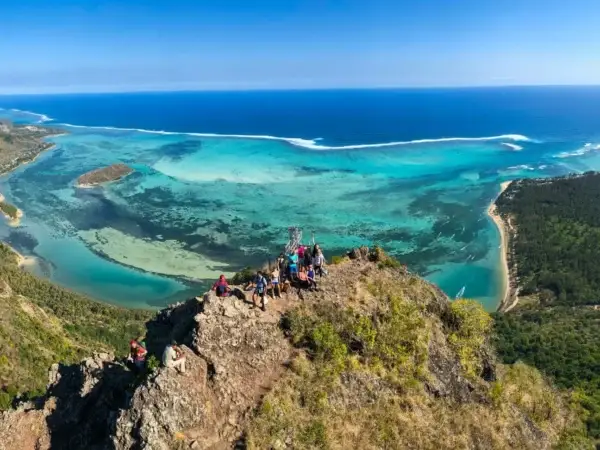
The climb up Le Morne Brabant, a UNESCO site, to the summit and its view over the southwest lagoon, with a certified guide.
€45.00




Jean-Christophe (JC)
Make room for endemic wildlife on your trip
Forest hike, nature park, outing at dusk: message us on WhatsApp with your dates and your children’s ages, and we will put together a nature-focused trip.
FAQ: bats in Mauritius
Yes. Mauritius has been home to 4 bat species. The best known is the Mauritian flying fox, which is endemic to the island.
Stay calm, keep your distance and do not try to touch it. If the animal is close, avoid sudden movements and let it leave.
The Mauritian flying fox is one of the best-known animals of Mauritius. It is also the largest endemic land mammal on the island.
For a traveler, the question is mostly about being careful in the field, not about fear. The Mauritian flying fox is not aggressive toward you if you watch it from a distance.
It is possible, especially if your hotel is near a tree-lined area or a more natural spot. Wide-open beaches are less likely places to see one, while areas near trees give you a better chance of seeing them fly by at dusk.
In practice, no. The Mauritian flying fox eats fruit and does not attack people. The only rule is the one for any wild animal: do not handle it, especially if it is injured or has fallen to the ground. Watched from a distance, on a walk or at dusk, it poses no risk to your trip.