Maha Shivaratri in Mauritius: the Grand Bassin pilgrimage
Maha Shivaratri in Mauritius is a major Hindu festival held between February and March, built around Shiva and the pilgrimage to Grand Bassin. If you want to understand this landmark ceremony of Mauritius, its date, its rituals and what you can see on site without a misstep, this article covers the essentials, from the figures of Shiva and Parvati to the Pashupatinath temple, so you can approach it with respect and curiosity.
Will you be in Mauritius during Maha Shivaratri?
Send us your dates on WhatsApp: if they fall during the festival, we plan your trips and visits around the pilgrimage to Grand Bassin.

A night of devotion that brings Hindu worshippers together
Across Mauritius, the Maha Shivaratri festival brings thousands of worshippers together in one shared vigil. The night of Shiva is marked by prayer, singing, offerings and visits to the sacred Shiva lingam in the temples. The mood is solemn but warm.
In several accounts, this night also recalls the Tandava, Shiva’s cosmic dance. It is this mix of silence, walking and devotion that makes the celebration so powerful. Even as a simple observer, you quickly sense that this is not a show but a real religious rite, observed with family.
Maha Shivaratri at a glance
Here is what to know before your visit:
- 🌙 Maha Shivaratri honors Shiva with a night of prayer and vigil.
- 🛕 In Mauritius, the main gathering takes place around Grand Bassin.
- 🙏 Worshippers fast, meditate and leave offerings at the temple.
- 🚶 Many make the pilgrimage on foot, sometimes over several days.
- 📅 The date changes every year according to the Hindu lunar calendar.
Maha Shivaratri, the great night dedicated to Shiva
Maha Shivaratri literally means the great night of Shiva. In Hinduism, this festival honors Shiva in his forms as protector, ascetic and transformer. He is also called Mahadeva, the great god, which says a lot about his place in the tradition.
Its meaning comes as much from mythology as from inner life. Some stories tell of the union of Shiva and Parvati. Others stress a night that favors spiritual discipline, self-control and prayer. The heart of the celebration is not commotion but presence.
For many Mauritians, this festival is a time to refocus. People slow down, stay awake, chant mantras and offer water, milk or sacred leaves. This celebration of Shiva is not folklore frozen in time. It stays alive, family-centered and widely followed. That is also what makes it so moving when you see it in person.
The spiritual reasons for a night-time celebration
Why is this festival observed at night rather than in broad daylight? Because the night of Shiva is tied to stepping back from noise, to mastering the mind and to a form of inner awakening. In many temples, the lights dim, the chanting goes on and time seems to slow down.
The Tandava, the cosmic dance attributed to Shiva, symbolizes both destruction and renewal. This idea sheds light on the whole festival. You leave behind what weighs you down to make room for a clearer awareness. The Shiva lingam, found in sanctuaries, represents this creative force without a human form. In some accounts, the luminous manifestation of Shiva is linked to the Jyotirlinga, a sign of an infinite presence.
This night-time celebration also has a very practical side. Staying awake, praying and fasting for a few hours takes real effort. It is precisely this small act of self-discipline that gives the rite its meaning. For many, the night is not only symbolic: it helps them feel fully present.


The mythology of Maha Shivaratri: the legends of Shiva
Several Hindu legends surround this night. They shed light on the meaning of the prayers and vigils.
The marriage of Shiva and Parvati
Maha Shivaratri celebrates, among other things, the union of Shiva and Parvati. This divine marriage symbolizes the meeting of consciousness, embodied by Shiva, and energy, the Shakti, embodied by Parvati. For many worshippers, the night is a chance to honor this love and the devotion behind it. It is one of the reasons couples and families pray together that evening.
Shiva and the poison of the Samudra Manthan
Another legend tells of the churning of the cosmic ocean, the Samudra Manthan, carried out by the gods and demons in search of the nectar of immortality. Before the nectar, a poison capable of destroying the world appeared. Shiva drank it to save the universe. The poison stayed in his throat, which turned blue, earning him the name Neelkanth, the one with the blue throat.
The cosmic dance of the Tandava
Shiva is also the master of the Tandava, his cosmic dance. Far from a simple movement, it represents the cycles of creation, preservation and destruction of the universe. Tradition holds that on the night of Maha Shivaratri, Shiva performs this dance at full intensity. Staying awake and meditating that night means tuning in to this energy.
When Maha Shivaratri falls: landmarks of the lunar calendar
The date of Maha Shivaratri changes every year, because it follows the Hindu lunar calendar. The festival falls on the fourteenth night of the waning moon, in the month of Phalguna according to the most common traditions. That is why it often lands between February and March.
To get your bearings: Maha Shivaratri is expected around March 6, 2027 in many Hindu calendars, including in Mauritius. On the island, the days leading up to it matter almost as much as the date itself, because the pilgrimage begins well ahead.
In the ritual setting, Vedic hymns such as the Sri Rudram, from the Yajur Veda, may be recited in some temples. These sacred texts praise Shiva under many names and add to the intensity of the vigil. If you are planning your trip, keep one thing in mind: to find the date of Maha Shivaratri in Mauritius, look at the local religious calendar, not only an international date.
Offerings, prayers and vigil: the essential gestures
The night is built around simple gestures, repeated with care. Worshippers go to the temple, recite prayers, chant mantras and pour offerings over the lingam. The vigil can last a long time, often until early morning.
The most common offerings are very symbolic. Bilva leaves have been associated with Shiva for centuries. People also offer water, milk, honey or ghee, depending on the temple’s customs and family habits. Each gesture expresses respect, purification and devotion.
- Bilva is placed on the lingam during prayer.
- Milk and honey are poured during the abhishekam, the ritual bath.
- Oil lamps and incense accompany the meditation and the chanting.
You do not need to do too much. As a visitor, the key is to follow the instructions of the place and observe before acting. A discreet gesture is better than improvised participation. It is the best way to respect the rituals of Maha Shivaratri without feeling lost.


Fasting without overdoing it: advice and caution
Fasting is one of the best-known practices of this festival, but it should not become a hardship. Many worshippers eat less or avoid certain foods before the vigil. Others observe a stricter fast, along with prayer and meditation.
If you want to take inspiration from it, go gently. Drink enough during the day, avoid unnecessary effort and do not attempt a severe fast if your health does not allow it. Sadhus practice a very advanced asceticism, but their practice is not a required model for a visitor or for a first try at home.
At home, you can mark the night in other ways. A candle, a quiet moment, a few mantras, a light meal or a short meditation are more than enough. The most important thing is intention. The point is not to hurt yourself but to make yourself inwardly available.

In Mauritius, the Grand Bassin pilgrimage is the high point
In Mauritius, the most striking moment of Shivaratri is the pilgrimage to Grand Bassin, also known as Ganga Talao. This sacred lake, set in the highlands, is one of the country’s great places of Hindu devotion. Thousands of pilgrims gather there every year, often on foot, carrying decorated structures called kanwars.
The atmosphere is impressive. Groups set out from the villages, walk for hours, sometimes several days, then arrive near the temples in a mix of tiredness and fervor. This Hindu pilgrimage in Mauritius is not reserved for a religious elite. It brings together families, young people and elders, and creates a real collective movement across the island.
On site, the monumental statue of Shiva and the sanctuaries around Ganga Talao give the place its full force. For a traveler, this is where you best understand what the festival means. Not just a date on the calendar, but a physical, symbolic and deeply shared journey.

Entering the temple and following the rhythm of the ceremony
In a Mauritian Hindu temple, everything is learned by watching. You take off your shoes, speak softly, follow the movement of the worshippers and avoid standing in front of people at prayer. A ceremony devoted to Shiva can seem very dense at first, but you quickly pick up the rhythm.
Bells, chants, lamps and the priest’s gestures structure the rite. You will sometimes see lines form to place an offering, touch the threshold of the sanctuary or bow before the lingam. In some places, people pass through quickly because of the crowds.
To take part in Shivaratri in Mauritius with respect, just keep it simple. Ask before taking photos, cover your shoulders and knees, and let worshippers go first. This restraint changes everything. It lets you take in Hindu celebrations in Mauritius as a welcome guest, not a hurried onlooker.

How can you attend Maha Shivaratri?
Attending this festival is entirely possible when you travel in Mauritius, as long as you arrive with respect and a little preparation.
🎟️ Can tourists join in?
Yes, a visitor can watch the celebrations and go to several temples open to the public. Simply dress modestly, take off your shoes at the entrance and stay quiet during prayers. The idea is not to consume the event but to follow along with respect.
📍 Where to go for the event
The most striking site is Grand Bassin, also called Ganga Talao, in the center of the island. You can also see processions in the villages and visit a Hindu temple near where you are staying. The Pashupatinath temple at Grand Bassin draws many worshippers during this period.
⏰ What time of day is best?
Morning is often the best time to avoid the biggest crowds, especially around the sacred lake. In the late afternoon and evening, the mood grows more intense with the chanting, the prayers and the vigil. For good viewing, arriving early is often the right call.
⏱️ How long should you plan for?
Allow at least half a day for Grand Bassin if you want to see the site without rushing. A shorter visit of one to two hours is enough for a local temple. During pilgrimage days, getting there by road can take longer than planned.
🎒 What to pack for Maha Shivaratri
The most useful approach is to stay light and practical.
- Comfortable clothing that covers your body, suited to the weather
- Water, especially during the day
- Shoes that are easy to take off
- A shawl or a light jacket for the evening
Avoid short outfits and noisy behavior. For photos, always ask permission when people are praying.
🛕 How to celebrate Maha Shivaratri at the temple or at home
At the temple, you can listen to the chanting, follow the line of worshippers and leave a simple offering if allowed. At home, many people choose a quiet prayer, a meditation, a light fast or listening to mantras dedicated to Shiva. In both cases, simplicity matters more than staging.

Agnès and JC’s tip
To attend Maha Shivaratri smoothly, book your lodging and transfers well in advance, especially around Grand Bassin, where demand climbs fast. Also pack water, modest clothing and good shoes: getting around on site can take longer than expected, and being prepared keeps the visit on track.
More to do during your stay
If you extend your stay after the festival: the Tamarind Falls hike (the 7 Cascades), kayaking on the Tamarin River or swimming with horses.
-
 Mangrove and pools
Kayaking on the Tamarin River (2.5 hours)
Paddle up the Tamarin River between mangrove and mountains, as far as the freshwater pools.
€35.00 -
The classic
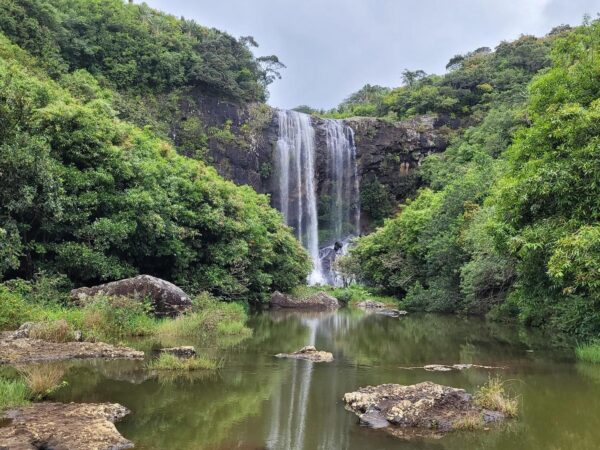
Tamarind Falls hike (3 hours)
The island’s best-known hike, to Tamarind Falls, in a small group, with a swim in the natural pools.
€39.00 -
From age 6
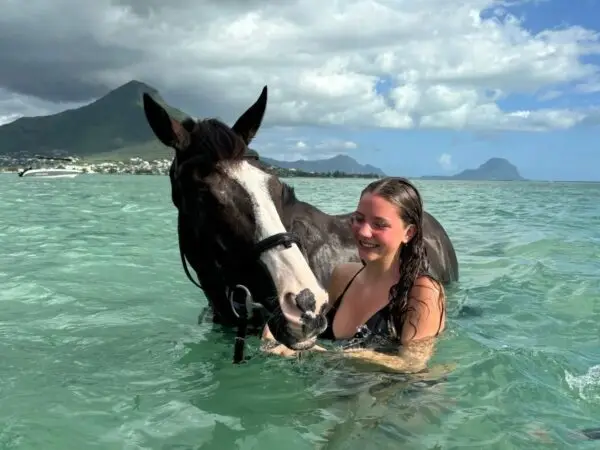
Swimming with horses at Flic en Flac (1 hour)
A horseback ride along Flic en Flac beach, then a swim with your horse in the lagoon, from age 6.
€90.00 / 3 hours



Agnès
Let’s plan your visit to Grand Bassin with respect for worshippers
Tell us your hotel and the day you are interested in on WhatsApp: we plan the trip to Grand Bassin and remind you of the etiquette to follow on site.
FAQ on Maha Shivaratri in Mauritius
Maha Shivaratri is a major Hindu festival dedicated to Shiva. It takes place over a night of prayer, fasting and spiritual vigil. In Mauritius, it becomes especially visible through the pilgrimage to Grand Bassin, also called Ganga Talao.
This festival honors Shiva as the deity of transformation, meditation and spiritual power. According to some traditions, it also recalls the union of Shiva and Parvati or a sacred manifestation of Shiva. For worshippers, it is a high point of inner purification.
The date changes every year, because it depends on the Hindu lunar calendar. It falls during the waning moon, often between February and March. In 2027, the celebration is expected around March 6 in many religious calendars.
The main rites are the night vigil, prayers, the chanting of mantras, fasting and offerings poured over the lingam. Some temples also recite sacred hymns. In Mauritius, the pilgrimage to Grand Bassin is a full part of the celebration.
The most common offerings are water, milk, honey, ghee and bilva leaves. They are placed with reverence during prayer. In some places, flowers, fruit or incense may also be offered, depending on the temple’s customs.
Fasting helps reduce the distractions of the body to make room for prayer and meditation. It also marks an effort of discipline and refocusing during the night of Shiva. The practice exists in other traditions of the Hindu world too, from Nepal to Mauritius.
Shivaratri is the night of Shiva, which comes back every month according to the Hindu lunar calendar, on the eve of the new moon. Maha Shivaratri, the great night, is the holiest of the year: it takes place once a year, in the month of Phalguna. It is the one that draws the big pilgrimage to Grand Bassin in Mauritius.